For the last year, Keswick Museum has been a pilot partner of The Sensational Museum, an AHRC-funded research project led by researchers at Royal Holloway, University of London, and the Universities of Westminster and Leicester. The project has supported pilot museums to work with co-creators to create sensory exhibits that are accessible to all – using what we know about disability to change how museums work for everyone.
Keswick Museum has launched its new exhibit which, unusually for a museum display, visitors are encouraged to touch, listen to, and smell. “Crafting the landscape: the journey of a piece of KSIA” was co-created with a pan-disabled group, and has been designed to be interacted with. Everyone in the co-creation group has lived experience of disability. The group worked with curators at the museum and designers from Barker Langham to co-create something that would communicate a narrative about the work of the Keswick School of Industrial Arts in a multisensory way.

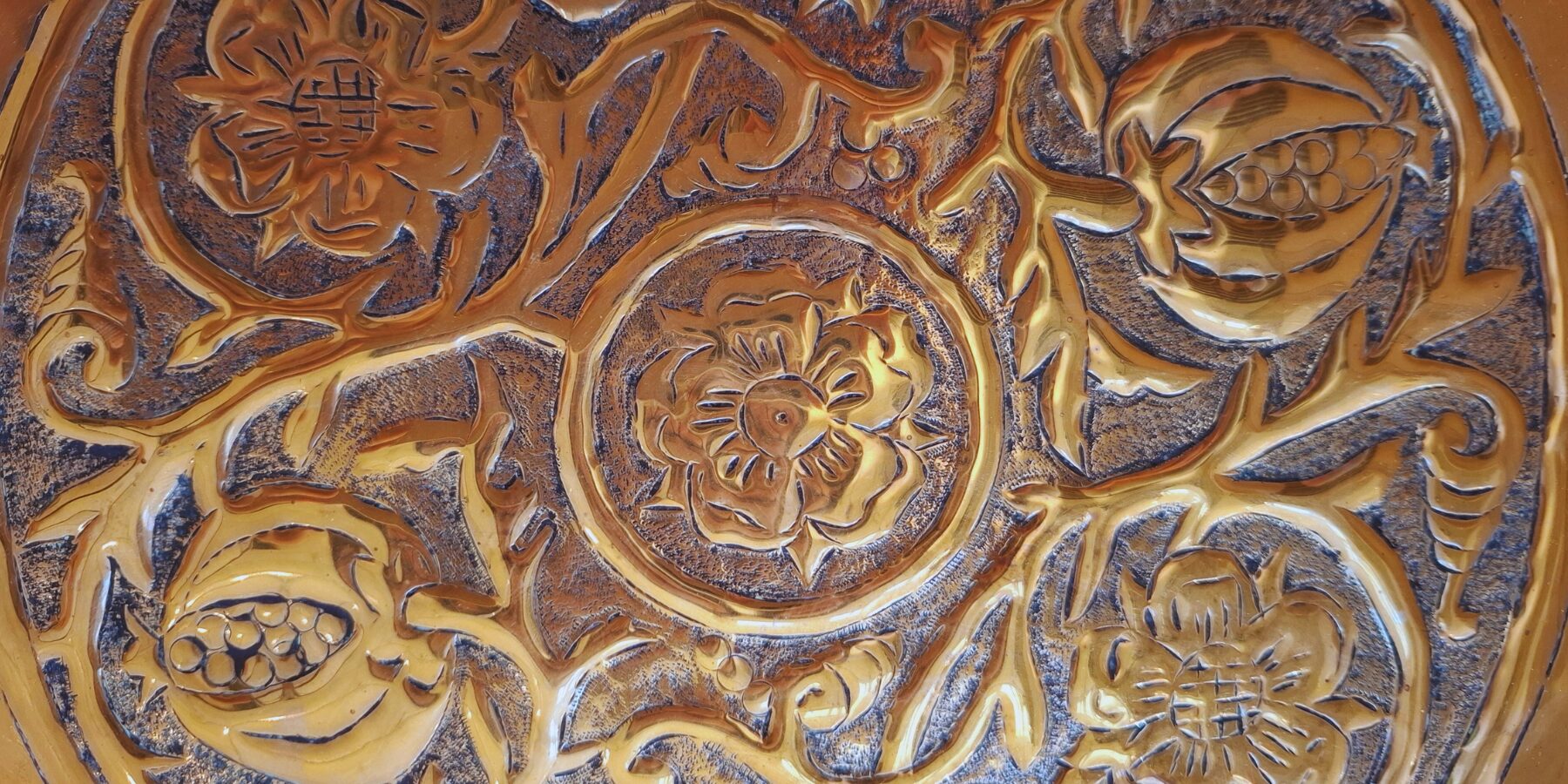
The installation tells the story of the creation of a piece of decorative art from the KSIA. Visitors can touch a wooden laser-cut map of Keswick and the Borrowdale valley to understand the geography of the area where copper was mined in Elizabethan times, inspiring its use by the KSIA. Stations around the map encourage people to touch and smell moss and copper nuggets, hammer a metal sheet, and touch a real object from the museum’s KSIA collection. Further interpretation is available through audio description, braille, and QR codes.

We asked some of the people involved to tell us more about the project and their experiences working on it. Here are interviews with our Curator, Nicola, who facilitated the project for Keswick Museum, and two of our co-creators, Sylvia and Sreeni.
NICOLA, curator and project facilitator
What is the project?
The Sensational Museum is a research project. Researchers at universities had come up with resources to make museums more multisensory, and they wanted a selection of pilot museums to test these resources to see if they worked and how they could be improved.
The idea behind it is that no one sense should be sufficient – whether it’s looking, listening, or touching. Museums should offer multiple ways to connect with the story of an object. So the project wanted us to work with people who have lived experience of different disabilities so we got a wide range of thinking about objects. This has resulted in an installation in Gallery 2 where we encourage people to get physically involved with it.
Why did the museum get involved?
We applied to be a pilot partner in 2024. We had just finished our time as part of a museum accessibility cohort, so our staff had learnt a lot about accessibility. When we saw this project we wanted to take the next step and push ourselves to do more. We’re lucky to have a team at the museum who were all committed to making the project a success.
What was your role?
I was the project facilitator for the museum, so I led the sessions the Sensational Museum team had provided to us all. Some of these were internal, so I delivered sessions to colleagues which helped us understand the concepts and prepare to work with a group of co-creators. Then I led four workshops with our co-creation group, using the Sensational Museum session plans to guide their discussions. Throughout these sessions they, supported by me, came up with the idea for the installation that is now on display.
What has changed for you as a result?
Facilitating the co-creation process was, for me personally, the most impactful part of the project. Alongside the project resources, this engaged, passionate and knowledgeable group massively changed my thinking through their thoughtfulness and advocacy, giving me confidence to try new things. We’re now looking at how we can offer quiet opening times to allow people more choice in how they can access our installation and other displays.
The project has challenged my thinking and I am now much more conscious of creating different ways into objects, and how I and my team can achieve that. It has definitely influenced our most recent exhibition which is much more experiential and audio-based than previous ones, and I am planning to work with co-creators again in the future.
SYLVIA & SREENI, co-creators
Why did you want to get involved in the co-creation group?
Sreeni: I have motor, sensory and mental issues, and so I wanted to see what could be done that would be accessible to someone else who shared similar disabilities.
Sylvia: I wanted to be involved in this project, to see if my years of working with disabled people and having a disability myself could benefit the installation.

What were the sessions like?
Sreeni: The sessions were very engaging and gave us plenty of food for thought. I found it most helpful to think of describing things so that people with visual problems can listen to audio or feel actual objects or braille.
Sylvia: Really enjoyed the sessions, who knew you could spend 30 mins describing bubble wrap! Makes you think very differently.
What has changed for you as a result?
Sreeni: Being more descriptive and not assuming things.
Sylvia: I have changed the way I look at things, and utilise all the skills I learnt to help others.
Click here to learn more about Crafting the Landscape, including a full audio description of the installation.


